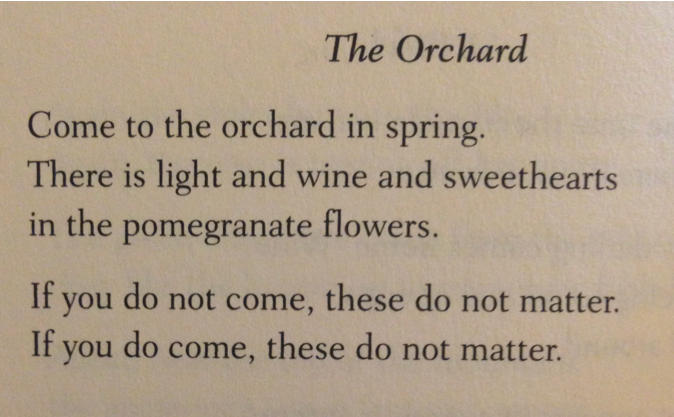
Come to the orchard in spring.
There is light and wine and sweethearts
in the pomegranate flowers.
If you do not come, these do not matter.
If you do come, these do not matter.
I often think of this poem as a tool for discovering what truly matters. The way it works is simple: replace the lover with the object of your desire(simply put whatever you desire), and the orchard with its alternative choice. If, in the presence or absence of that desire, the alternative becomes completely meaningless, then you have your answer.
Sources
The poem commonly known as “Come to the Orchard in Spring” appears — in English — in the collection The Essential Rumi, a popular anthology translated and interpreted by Coleman Barks. persweb.wabash.edu+1
According to scholarly sources, this quatrain corresponds to number F-888 in the critical catalog of Rumi’s quatrains prepared by Badi’ al‑Zaman Foruzanfar. Google Groups+1
The original poems of Rumi are part of the collection Divan‑i Shams‑i Tabrizi, a massive Persian-language anthology of lyric poems and ghazals — although it is not always straightforward to match a popular English “Barks translation” back to a specific Persian original.
Credits
Open AI Language Model for polishing readability.
Music : UA
Leave a Reply