While I am searching for architects in India who have been looking creatively into addressing the challenges of assimilating low-cost houses for urban areas, Charles Correa was a recurring name. Though his materials were not natural, he appeared to have empathy and simplicity in his design, and he really believed everyone, regardless of their social or economic class, deserved respectable living.
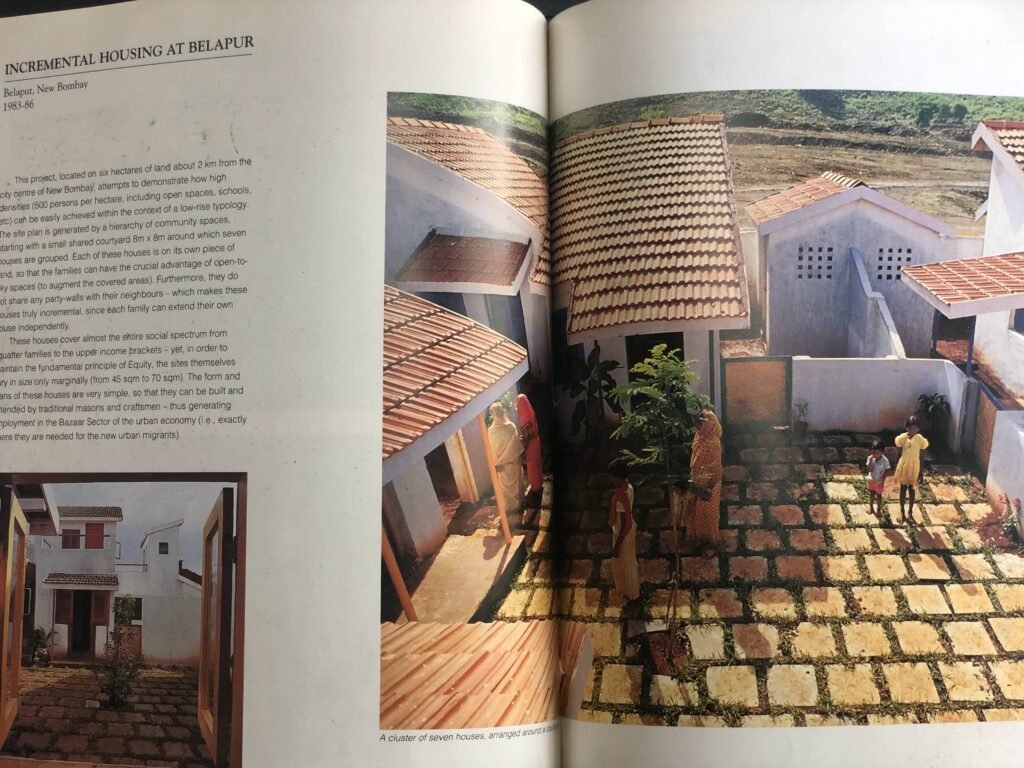
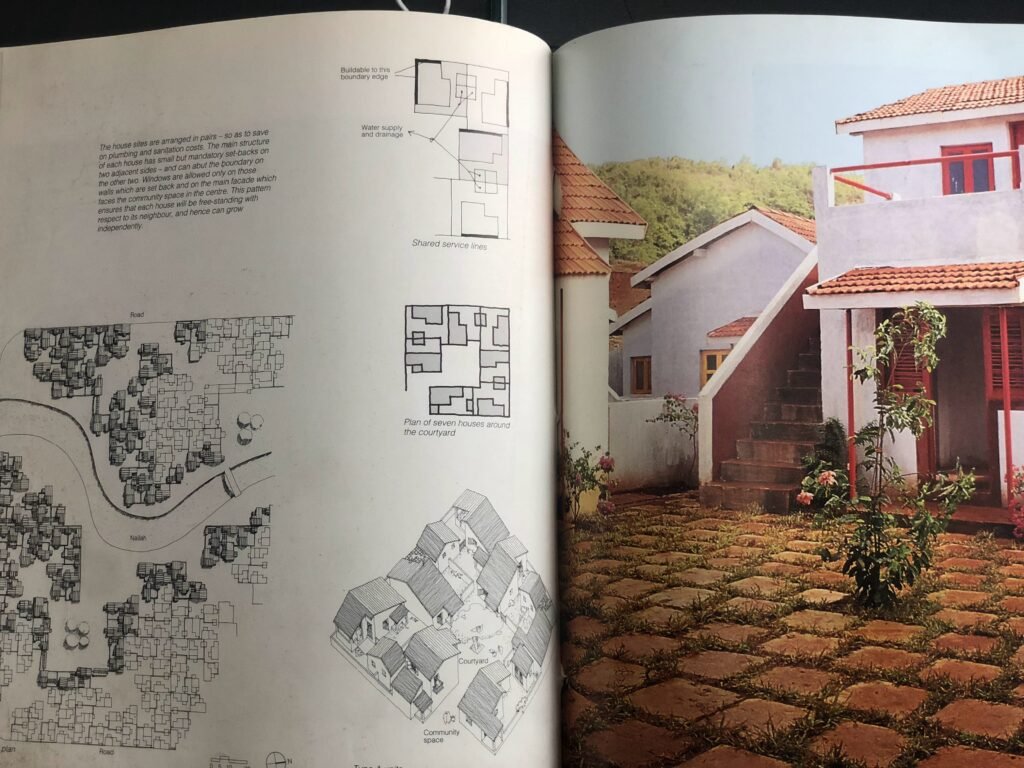
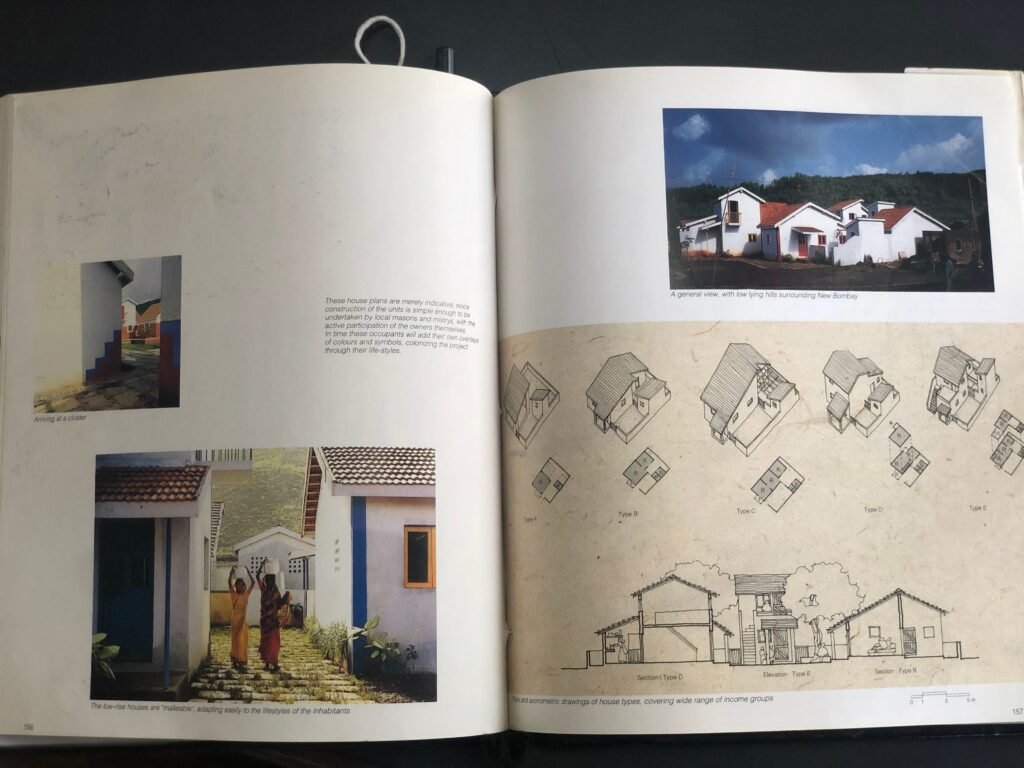
I am reproducing some photographic images I took from a book I found in the Library of National College of Arts. I don’t know if there will be copyright infringement in me reproducing them here; however, I am sharing them in good faith anyway. The pages have legible textual commentary.
The thing I love about this is its evolving nature: you don’t build the complete house when you begin. You may have a small family with limited needs today. Why spend your money today? Also, you may not know all of your needs today, so it’s a good idea to begin small and keep the space for future increments.
Below this line, I have used chatgpt 4.o to help me do research and compose the text.
Charles Correa’s Incremental Housing at Belapur, in Navi Mumbai, stands as a pioneering example of how communities can grow and adapt without losing their sense of identity. When Correa first started on this project in the late 1970s and early 1980s, he was fascinated by the vibrancy of local neighborhoods—he once mentioned how he’d wander through busy alleyways, chatting with residents about their needs, habits, and future aspirations. This grassroots dialogue shaped an approach that gave families a flexible, expandable housing frame, rather than a fixed, rigid structure
The essence of Belapur’s design is “incremental” growth: each family starts with a small core unit that can be extended over time. Correa believed that families—and cities—aren’t static; they need to evolve. By leaving open terraces, courtyards, and half-built walls, he allowed people to add more rooms as their finances and household sizes changed. He famously joked that this was “architecture that grows like a living organism,” and in many ways, that’s exactly what happened. Residents took ownership of their houses, shaping them in ways that reflected their culture, their needs, and their personalities.
In today’s bustling cities—whether you’re in Rio de Janeiro, Nairobi, or Manila—the idea of incremental building can solve a common problem: how to house growing populations while ensuring every family has space to shape their own destiny. Correa’s project reminds us that housing should be more than just shelter; it should be a living framework for everyday life. And as modern technologies allow us to build swiftly and cheaply, we can incorporate Correa’s human-centered philosophy to keep costs low while building strong, sustainable neighborhoods.
References & Further Reading:
- Charles Correa Foundation – (https://charlescorreafoundation.org/)
- “The New Landscape” by Charles Correa (Book)
- “Charles Correa” – Website & Archives (charlescorrea.net)
Credits:
Essay composed with creative assistance from OpenAI’s ChatGPT.
Leave a Reply